


Imagine discovering that someone knows the password to your casino account. That sounds serious, but a stolen password does not necessarily have to mean immediate account access.
Two-Factor Authentication at Online Casinos can require another piece of evidence before a login succeeds, making password theft less useful to an attacker.
From SMS codes and authenticator apps to security keys and passkeys, different verification methods provide different levels of protection.
Knowing their strengths and weaknesses can help players understand which account-security features matter and how to use them correctly.
Why Online Casino Accounts Need More Than Passwords
An online casino account can contain information criminals may consider valuable.
Apart from an account balance, there may be an email address, phone number, transaction records, payment details, personal information, and identity-verification history.
The password protecting this information can be exposed in several ways.
Phishing can trick someone into revealing credentials. Malware may steal them. A data breach at another website can also expose a reused password.
OWASP recommends MFA because compromised and reused passwords remain major causes of account attacks. It describes multi-factor authentication as an important defense against brute force, credential stuffing, and password spraying.
What Counts as Genuine Two-Factor Authentication?
True 2FA combines different authentication categories.
The first factor may be something you know, such as a password.
The second could be something you have, such as a phone, authenticator application, or hardware security key. Another possibility is something you are, such as a biometric characteristic.
Using a password followed by another memorized PIN is not necessarily genuine multi-factor authentication because both are based on knowledge.
OWASP emphasizes that the factors should be independent so compromising one does not automatically compromise the other.
This independence is what gives 2FA much of its security value.
A Practical Casino Login Example
Consider a player called Alex.
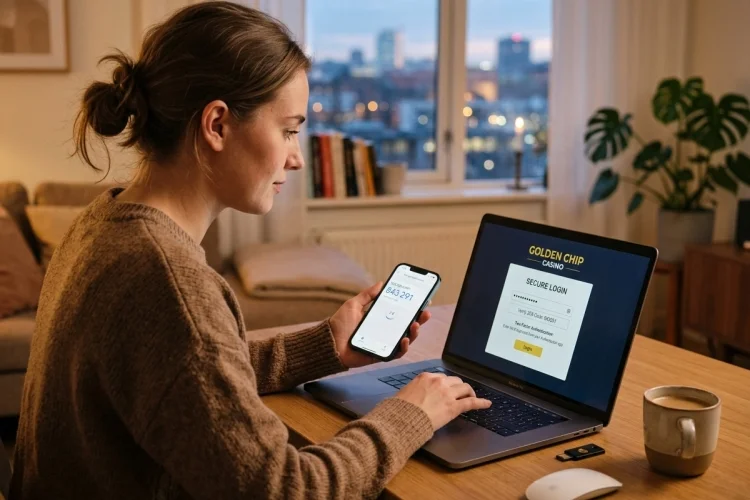
Alex enters an email address and unique password into a casino account. The login credentials are correct, but the site does not immediately open the account dashboard.
Instead, it requests a temporary verification code generated by an authenticator app.
Alex opens the app, reads the current code, and enters it into the casino login page. Only then is access granted.
Now imagine that a criminal has obtained Alex’s password.
The criminal can complete the first step but cannot automatically complete the second one because the authenticator device is still controlled by Alex.
This seperate requirement turns a stolen password from a complete login credential into only one piece of the puzzle.
SMS Codes: Useful but Not the Strongest Option
SMS-based authentication is easy to understand.
After entering a password, the service sends a code to the registered phone number. Entering that code completes verification.
For many users, SMS 2FA is better than relying exclusively on a password.
However, SMS introduces weaknesses.
Attackers may attempt SIM-swapping attacks, compromise mobile accounts, intercept messages in some circumstances, or simply trick users into providing their code through phishing.
NIST explains that some MFA methods, including SMS and one-time PIN approaches, remain vulnerable to phishing. It recommends phishing-resistant authentication when stronger assurance is required.
So if a casino offers both SMS and stronger alternatives, understanding the difference is useful.
Authenticator Apps and TOTP Codes
Authenticator apps generally use a system called Time-Based One-Time Password, or TOTP.
After setup, the app and service share a secret that allows the app to generate frequently changing codes.
The player normally enters the current code after providing a password.
One advantage is that the code does not need to arrive through an SMS network. This avoids certain risks associated with mobile phone numbers and message delivery.
OWASP identifies TOTP as a common possession-based authentication method and recommends it as a practical MFA option for many web applications.
However, TOTP codes can still be phished.
If someone enters both their password and temporary code into a convincing fake casino website, an attacker may attempt to use those credentials immediately.
Security Keys and Passkeys Offer Stronger Phishing Protection
Security keys use cryptographic authentication rather than relying on a manually entered temporary code.
They may be physical USB or NFC devices, or authentication capabilities built into phones and computers.
Passkeys use related modern standards and can combine possession of a device with a PIN or biometric confirmation.
A major advantage is phishing resistance.
NIST points to FIDO authenticators used with WebAuthn as a widely available form of phishing-resistant authentication.
OWASP similarly describes passkeys as a highly secure option because authentication is linked cryptographically to the genuine service.
Not every online casino offers these options, but when they are supported they represent a stronger approach than manually typing reusable or temporary secrets into a webpage.
2FA Can Help Against Credential Stuffing
Credential stuffing is particularly relevant to people who reuse passwords.
Imagine the same email and password were used on both an entertainment website and a casino account.
If the first site suffers a breach, attackers may automatically test those credentials on hundreds of other platforms.
Without 2FA, a reused password could immediately expose the second account.
With an independent second factor, the password alone may no longer be sufficient.
OWASP specifically highlights multi-factor authentication as a powerful defense against credential stuffing and password spraying.
Of course, the better strategy is still to avoid password reuse entirely.
Sensitive Account Actions Need Protection Too
Authentication should not focus only on initial login.
High-risk account changes can be equally important.
An attacker who gains access to an existing session might try to change the registered email, replace an authentication factor, disable 2FA, or alter recovery settings.
OWASP recommends requiring existing authentication factors again before allowing changes to MFA settings and treating factor replacement as a high-risk activity.
This prevents an attacker from easily replacing the legitimate owner’s security settings after obtaining temporary account access.
A well-designed platform may also send a seperate notification when important security settings change.
Beware of MFA Fatigue and Fake Requests
Some authentication systems send approval prompts to a user’s phone.
Attackers may repeatedly trigger these prompts and hope the victim eventually presses “Approve” just to stop the interruptions.
Players should never approve a login request they did not initiate.
An unexpected verification code or approval notifcation can actually be a warning that someone already knows the account password.
Rather than approving it, access the legitimate service directly, review account activity if available, and change the password.
The same caution applies when someone claiming to be customer support asks for a one-time code. Verification codes should generally be treated like temporary passwords.
Recovery Codes Are Part of Your Security
Strong 2FA creates an obvious challenge: what happens when the phone is lost or the authenticator application becomes unavailable?
Many systems solve this with backup or recovery codes.
Google, for example, allows users to store backup codes for situations where their normal second verification method is unavailable.
If a casino provides similar recovery codes, keep them somewhere safe and seperate from your normal authentication device.
Do not leave them in screenshots that automatically sync to unsecured services.
Recovery mechanisms deserve careful protection because attackers sometimes target account recovery rather than trying to defeat strong authentication directly.
2FA Is One Layer, Not Complete Security
Two-factor authentication cannot prevent every type of account compromise.
A phishing attack might capture certain one-time codes. Malware on a device may steal active sessions. Poor account-recovery procedures can also create another route into an account.
Security therefore works best in layers.
Use a unique password, enable the strongest available second factor, verify casino domain names carefully, keep devices updated, and avoid suspicious login links.
Players should also remember that 2FA says nothing about whether a casino is licensed, financially trustworthy, or fair. It protects authentication; it is not a substitute for evaluating the operator itself.
Two-Factor Authentication at Online Casinos can make stolen passwords significantly less useful by requiring another independent verification factor.
SMS offers basic additional protection, while authenticator apps, security keys, and passkeys can provide stronger options.
Enable 2FA when available, secure your recovery methods, reject unexpected verification requests, and combine it with unique passwords and careful phishing awareness for better account protection.
